
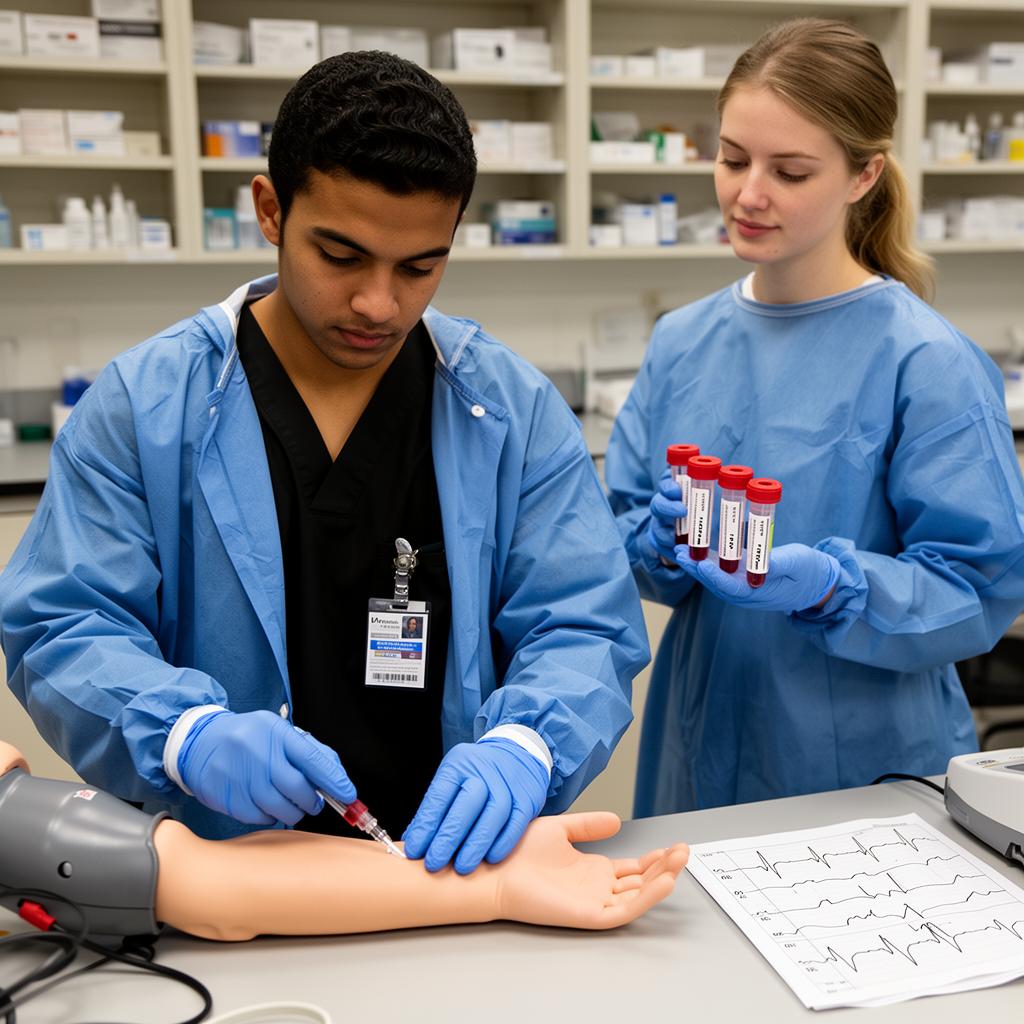
Lab Assistant, EKG Technician/Phlebotomist
Prepare for entry-level laboratory, EKG, and phlebotomy roles. Learn laboratory procedures, electrocardiogram testing, and professional blood collection techniques.
720 Clock Hours
Program Length
Diploma
Program Credential
Small Classes
Personal Attention
Career Services
Job Search Support
Three Skills, One Program
Trains students in clinical laboratory procedures, EKG fundamentals, and phlebotomy — including specimen collection, handling, and processing — at Lamson's Loop 410 campus in San Antonio.160-Hour Hands-On Externship
Includes a 160-hour externship at an approved San Antonio-area site, during which students must complete at least 50 successful blood draws and 10 successful skin punctures.Three Industry Certifications
Graduates may be eligible to test for the Certified Phlebotomy Technician (PH1), Medical Lab Assistant (ML1), and EKG Technician (EKG1) certifications through NCCT, and are also CPR certified. Lamson pays for the first attempt of each.
Training That Prepares You — Not Just Passes You Through
A shorter program can get you to graduation sooner — but what really matters is whether you’re ready on your first day of work. Lamson’s Lab Assistant, EKG Technician/Phlebotomist program is built around the hands-on hours and real-world experience that employers look for, so you finish prepared, not just finished. And you can still complete it in as few as 9 months.
Three healthcare skills in one program
Clinical laboratory procedures, EKG, and phlebotomy — giving you flexibility across more hiring settings.
A 160-hour hands-on externship
At an approved San Antonio-area site, where you complete at least 50 successful blood draws and 10 skin punctures.
Prepared for three certifications
The program prepares you to test for the NCCT Phlebotomy (PH1), Medical Lab Assistant (ML1), and EKG (EKG1) certifications, and you graduate CPR certified.
Request Information
Fill out the form below — no obligation
Financial aid for those who qualify.
Explore Financial AidProgram Overview
Our Lab Assistant, EKG Technician/Phlebotomist diploma program prepares you for entry-level opportunities in diagnostic healthcare. Learn phlebotomy techniques, EKG procedures, and laboratory skills, and apply your training during a supervised externship. The program prepares students to take relevant certification exams; earning those credentials requires passing the exams.
The Lab Assistant, EKG Technician/Phlebotomist program is offered at our Northwest San Antonio campus, where small classes and hands-on labs are part of an ACCET-accredited career training environment. Tuition assistance is available through our financial aid options for those who qualify, and graduates receive ongoing support from our career services team as well as introductions to local healthcare employer partners. Ready to apply? Review the steps on our admissions and enrollment page.
Curriculum Highlights
Certifications This Program Prepares You For
Certified Phlebotomy Technician (PH1)
National Center for Competency Testing (NCCT)
The program prepares students to test for this phlebotomy certification. Lamson pays for the first attempt.
Medical Lab Assistant (ML1)
National Center for Competency Testing (NCCT)
The program prepares students to test for this medical lab assistant certification. Lamson pays for the first attempt.
EKG Technician (EKG1)
National Center for Competency Testing (NCCT)
The program prepares students to test for this EKG certification. Lamson pays for the first attempt. Graduates are also CPR certified.
Where This Career Path Can Take You
Explore the career paths and advancement opportunities available after completing this program.
Phlebotomist / EKG Tech
Draw blood, perform EKGs, and process laboratory specimens.
Senior Lab Technician
Handle complex specimens and train new phlebotomists.
Lab Team Lead
Coordinate lab operations and ensure quality control standards.
Laboratory Supervisor / Manager
Manage lab staff, budgets, and compliance with regulations.
Request Information
Fill out the form below — no obligation
Financial aid for those who qualify.
Explore Financial AidCourse & Module Breakdown
Lamson's Lab Assistant, EKG Technician/Phlebotomist curriculum at our San Antonio campus is structured into focused modules. Below is what students cover in each module:
LA101 Module A — Laboratory Safety and Integumentary System80 hours · Prerequisite: No prerequisite
Orientation and development of an understanding of laboratory safety and universal precautions. Covers anatomy and physiology of the integumentary system. Students learn about nosocomial infections and the proper handling of body fluids, specimen requisitions, and specimens. Covers various instruments used to gather specimens, proper sterilization, the chain of infection, and factors influencing diseases. Lab work includes use of the microscope and centrifuge.
LA201 Module B — Blood, Urinary, and Reproductive Systems80 hours · Prerequisite: No prerequisite
Students learn the various characteristics of blood and its functions. Covers diagnostic tests associated with red blood cells, white blood cells, and platelets, plus the components of the urinary and reproductive systems. Includes instruction on sexually transmitted diseases and related tests and treatments. Students learn homeostasis, the components of the urinary system, routine urinalysis, and proper procedures for collecting urine samples.
LA301 Module C — Respiratory and Cardiac Systems / EKG Fundamentals80 hours · Prerequisite: No prerequisite
Students learn about the respiratory and cardiac systems through lecture and visual aids. Covers various heart-related diseases and corresponding treatments. Students learn the EKG process, how to read basic EKG strips, and cardiac rhythms. Hands-on lab practice under instructor supervision throughout.
LA401 Module D — Endocrine and Digestive Systems / Specimen Handling80 hours · Prerequisite: No prerequisite
Covers the differences between serum and plasma. Students learn about lipids and associated tests, how fasting affects blood sugar, post-prandial and glucose tolerance tests, and the various aspects of time and measurement related to specimens. Includes anatomy and physiology of the endocrine and digestive systems, plus interdependence of hormones and pregnancy. Lab training continues with methods of classifying microorganisms and disease issues relevant to a laboratory setting.
LA501 Module E — Nervous System, Therapeutic Drug Monitoring, and Behavioral Health80 hours · Prerequisite: No prerequisite
Covers anatomy and physiology of the nervous system. Includes basic psychology of how attitudes and interests influence human behavior and the challenges of being a healthcare provider. Students learn therapeutic drug monitoring, common therapeutic drugs, drug-testing reasons and specimen types. Covers the CLIA chain of custody and levels of complexity. Students learn to recognize behavior patterns and devise goals for improving work habits, attitudes, and problem solving.
LA601 Module F — Phlebotomy80 hours · Prerequisite: No prerequisite
Defines phlebotomy and the professional qualities of a phlebotomist. Covers informed consent, patient confidentiality, and legal issues for phlebotomists, plus immunology. Continued training on safety procedures, universal precautions, vein identification, "order of draw," and proper blood-collection procedures. Covers complications with patients, ABO blood groups, and Universal Donors/Recipients.
LA701 Module G — Body Systems and Musculoskeletal Anatomy80 hours · Prerequisite: No prerequisite
Students identify body planes and positions and describe the body cavity. Covers anatomy and physiology of the muscular skeletal system. Includes instruction on diseases specific to the nervous system. Continued hands-on lab practice under instructor supervision.
EXT801 — Externship160 hours · Prerequisite: LA101–LA701
After completing required classroom coursework, students proceed to an externship at an approved San Antonio-area site. The 160-hour externship provides a realistic San Antonio work environment to apply skills learned in the classroom. Externs perform their work under supervision of assigned personnel. Students must complete at least 50 successful blood draws and 10 successful skin punctures. Time sheets signed by the supervisor are submitted weekly. All externship hours must be completed to fulfill program requirements.
Career Outcomes
San Antonio is home to a large and active healthcare sector, including a wide range of medical practices, clinics, hospitals, urgent care centers, diagnostic laboratories, and specialty providers across the metro area. Graduates of Lamson's Lab Assistant, EKG Technician/Phlebotomist program may qualify for a variety of entry-level job titles, depending on the specific roles and certifications they pursue. Examples of entry-level job titles include:
- EKG Technician
- Phlebotomist
- Phlebotomy Technician
- Laboratory Assistant
- Medical Laboratory Technician
- Mobile Phlebotomist
- Mobile Examiner
- Specimen Processor
- Specimen Technician
- Lab Aide
- Patient Care Technician
- Dialysis Technician
- Medical Equipment Preparer
- Biological Technician
- Paramedical Examiner
Note: This list reflects examples of entry-level job titles graduates may pursue. Lamson does not promise or guarantee employment to any student or graduate. Some entry-level positions may require additional certifications, background checks, drug screenings, or state licensure not provided by the Lamson program.
Learn more about career services support for Lamson graduates, review admissions and enrollment steps, or explore financial aid options for those who qualify.
Training for a Lab, EKG & Phlebotomy Career in San Antonio
San Antonio's healthcare sector — anchored by the South Texas Medical Center — includes a wide range of community hospitals, urgent care centers, diagnostic laboratories, dialysis clinics, outpatient facilities, and physician practices spread across the metro area.
Lamson's Lab Assistant, EKG Technician/Phlebotomist program at our Loop 410 campus is structured to provide foundational training in three related areas — laboratory procedures, EKG, and phlebotomy — giving graduates flexibility across multiple healthcare settings. The program includes a supervised 160-hour externship at an approved San Antonio-area site, during which students must complete at least 50 successful blood draws and 10 successful skin punctures.
Lamson's Loop 410 campus is located at 5819 N.W. Loop 410, Suite 160, San Antonio, TX 78238, serving students from across the San Antonio metro area including Leon Valley, Balcones Heights, Castle Hills, Helotes, Shavano Park, and the Medical Center area. Explore all Lamson programs or learn how financial aid is available to those who qualify.
Important Disclosures
- Lamson offers career education and training. Lamson does not offer employment.
- Lamson does not promise or guarantee employment to any student or graduate.
- Career outcomes are not guaranteed and vary based on individual circumstances.
- Some entry-level positions may require additional certifications, examinations, background checks, drug screenings, and/or state licensure that are not part of the Lamson program.
- Financial aid is available to those who qualify.
- Lamson Institute is accredited by the Accrediting Council for Continuing Education & Training (ACCET), and is approved and regulated by the Texas Workforce Commission, Career Schools and Colleges Section, Austin, Texas.
Related at Lamson Institute
Continue exploring how Lamson Institute supports Lab Assistant, EKG Technician/Phlebotomist students from enrollment through graduation.
Frequently Asked Questions
What does Lamson's Lab Assistant program prepare students for?
Does the program cover EKG and phlebotomy?
How long is Lamson's Lab Assistant program?
What certifications does the program prepare students for?
What are the admission requirements?
Is financial aid available?
Explore Other Programs
Not sure if this program is right for you? Check out our other career training options.
View All Programs